10 May 2026
|
Jonathan Segal
The AWE Research Poster Track
AWE USA 2026
Augmented World Expo, better known as AWE, is one of the central gathering places for the extended reality community. The event brings together people working across XR for several days of talks, exhibitions, demos, and conversations about where the field has been and where it is headed next.
I first heard about AWE from Francisco Ortega, a professor I work with, who encouraged me to attend because my doctoral research focuses heavily on augmented reality. When I first attended as a volunteer in the summer of 2024, I quickly understood why the event mattered. I was able to experience new XR technologies firsthand, speak with renowned innovators and academics, and feel the momentum surrounding the field.
One of the highlights was meeting well-known academics whose work I had read, cited, and followed. They were contributing to the larger XR conversation alongside industry leaders, startups, and creators. Seeing those communities together made me think about how valuable it would be to create a more dedicated space for research at AWE, one where academic labs, students, and independent researchers could share posters, demo prototypes, and have deeper conversations with the broader XR community.
I am currently pursuing my PhD at Cornell Tech, where my work explores how AR can support teamwork in healthcare settings. I spend a lot of time at academic conferences where XR research is shared through papers, posters, and demos. Those venues are essential, but they often sit apart from the broader ecosystem of builders, startups, creators, investors, and independent developers shaping the future of XR. AWE brought those communities together, making a dedicated research poster track feel like a natural next step.
In the summer of 2025, I reached out to Ori Inbar at AWE to propose the idea. I imagined a space where researchers could bring their work directly to the expo floor, not just as static summaries, but as posters and demos that attendees could engage with directly. The goal was to give people a chance to see the work, speak with the researchers, and, when possible, try the systems firsthand.
That idea became the AWE 2026 Research Poster Track.
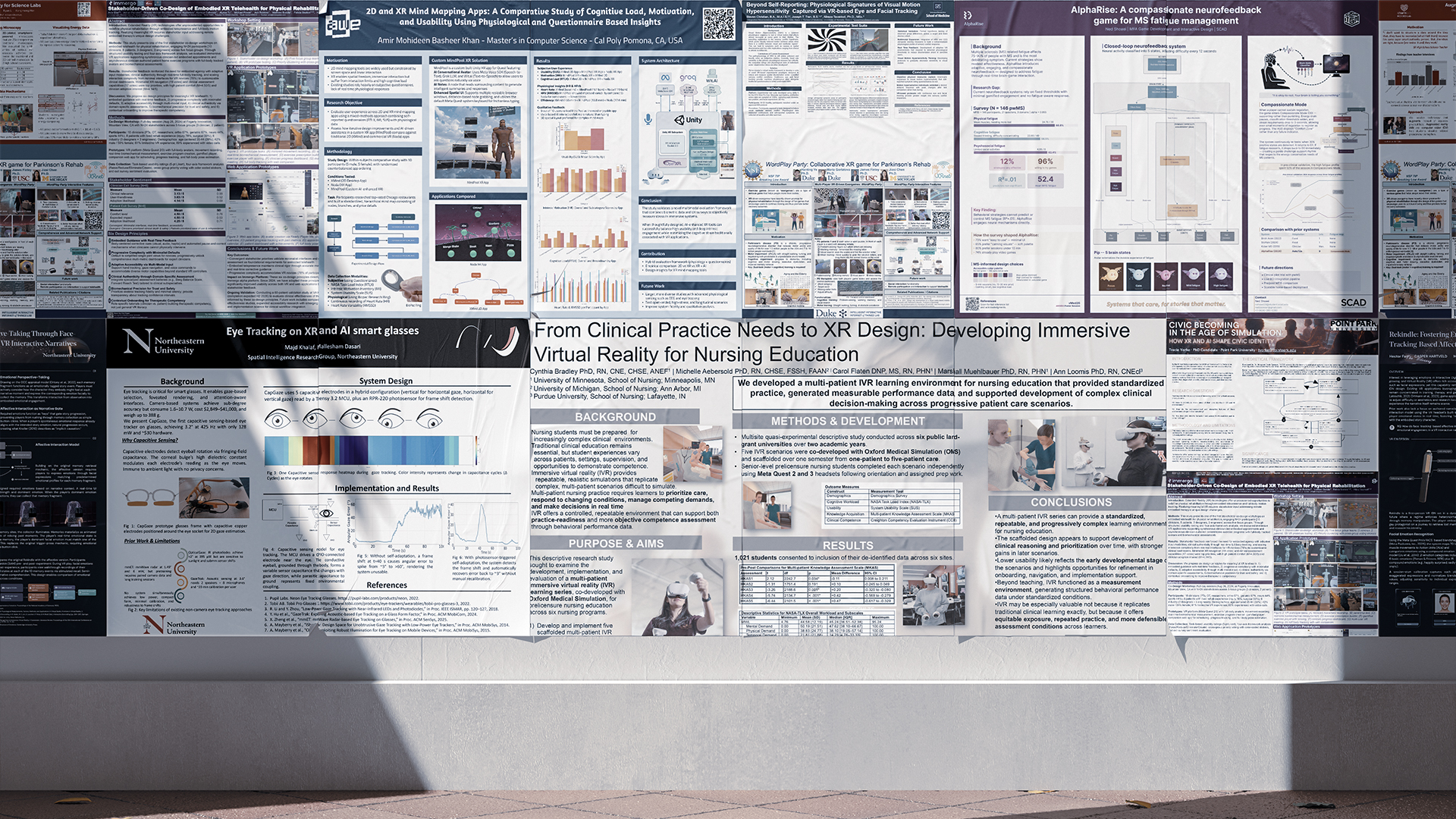
The call for posters positioned the track as a way to bring cutting-edge research directly onto the expo floor. Accepted posters will be displayed throughout AWE USA 2026. Presenters will take part in dedicated poster hours each day, join networking opportunities with senior researchers and industry leaders, and standout projects have also been invited to give lightning talks on the expo stage.
The submission guidelines were intentionally broad, welcoming published, under-review, and in-progress work from academic, industry, and independent researchers. Because the track is non-archival, submitting to AWE does not prevent authors from publishing the work elsewhere later. Interactivity was central to the track. Demos were strongly encouraged and prioritized during selection because, at AWE, a research poster should not only explain an idea. It should give attendees something to see, try, question, and experience.
This year, I had the opportunity to help organize and chair the AWE 2026 Research Poster Track. The most meaningful part was not only seeing the final set of accepted posters coming together, but helping shape a program that balanced research rigor, interactivity, and real-world relevance.
We received 40 submissions from across the XR research community, spanning healthcare, interaction design, neuroscience, systems, narrative experiences, education, collaboration, digital twins, perception, and AI-enabled spatial tools. The pool reflected a strong academic presence, with about 75 percent of submissions coming from academic contributors, and a strong early-career presence, with about 65 percent coming from graduate students. Healthcare was the largest category, showing how quickly XR is moving into real-world applications, while the broader submission pool reflected the range of topics shaping the field.
Then came review and selection. We invited members of the submission pool to contribute as reviewers, creating a community-driven process grounded in expertise across XR. Submissions were evaluated on technical quality and novelty, clarity of contribution, demo strength, and relevance to the broader XR community. In the end, we selected 15 posters, a 37.5 percent acceptance rate. The final program emphasizes diversity across six XR domains, strong representation of early-career researchers, and a high proportion of interactive work.
At the event, accepted demos will range from VR and AR experiences to interactive simulations, physical prototypes, and hybrid systems that combine AI, sensing, and spatial interaction. Together, they will give attendees a way to engage with the research beyond reading a block of text on a poster board.
A few posters were also selected for short talks, giving standout projects another way to reach the AWE audience. These projects were chosen based on reviewer feedback, clarity of story, strength of contribution, demo readiness, and their potential to resonate beyond a narrow research niche.
To me, the most exciting part of this process is the opportunity to bring different parts of the XR community into closer conversation. Academic researchers, industry teams, startups, creators, clinicians, designers, and independent developers are often working on related problems from different angles. AWE creates a rare environment where those groups can meet around work that is not only written about, but also demonstrated, tested, and experienced.
Organizing this track reminded me that curation is also a form of community building. A strong program is not just a list of top-scoring submissions. It is a way of creating connections between people, ideas, and possible futures. For AWE 2026, the poster track is designed to highlight research that is rigorous, interactive, and relevant to the broader XR ecosystem while also opening the door to new collaborations and opportunities.
What started as a thought I had while walking around AWE in 2024 has now become a dedicated research track at one of the most important XR events in the world. I am excited to see these projects come to life on the expo floor and to see what conversations, collaborations, and future work emerge from bringing these communities together.