18 Sep 2025
|
Mike Boland
AWE Talks: A Bushel of Bushnell's
AWE USA 2025
Welcome back to AWE Talks, our series that revisits the best AWE conference sessions. With AWE USA 2025 concluded, we have a fresh batch of session footage to sink our teeth into for weeks to come.
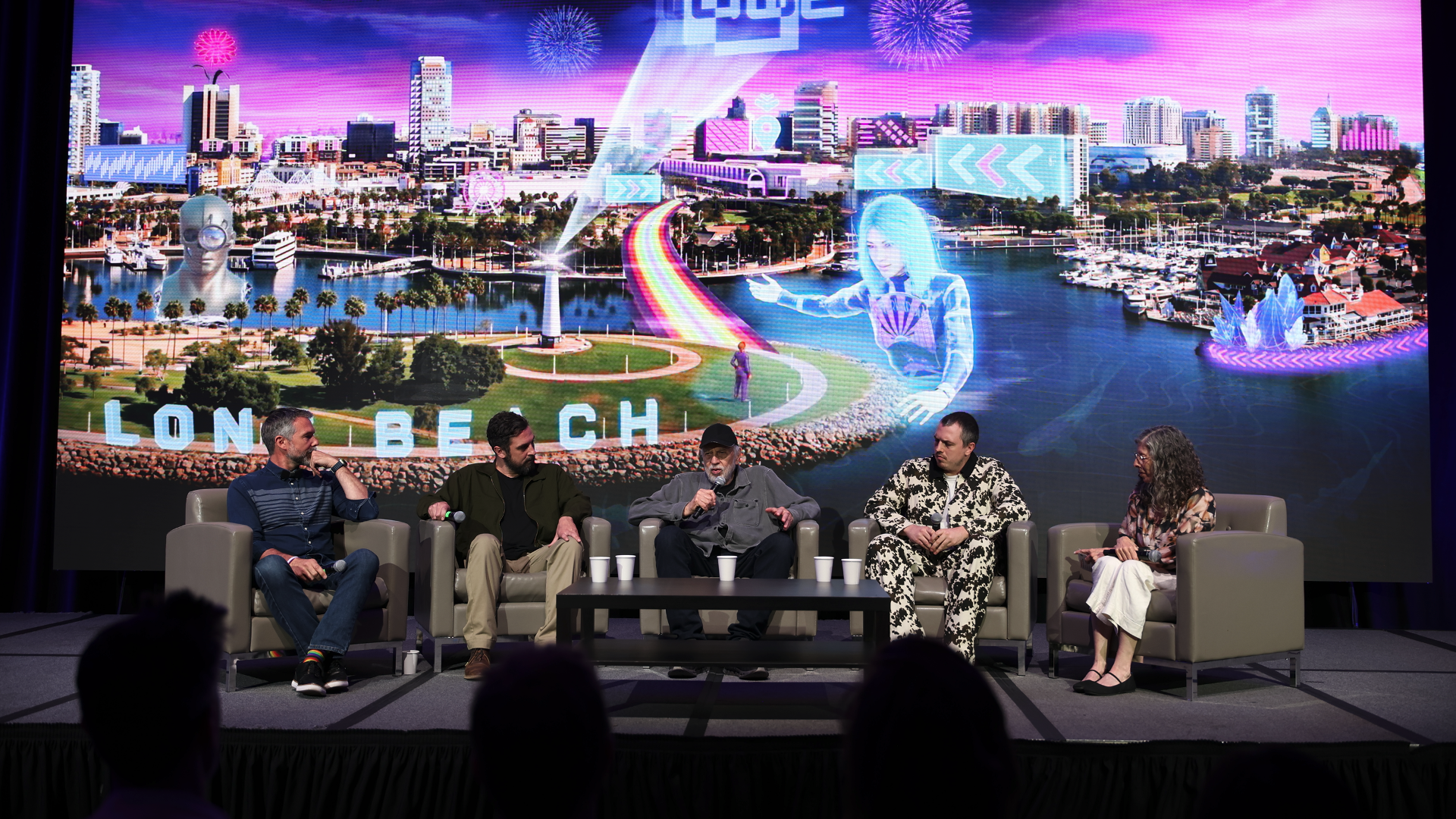
We continue the action this week with an entertaining and enlightening view into the dynamics of the gaming world. Where is it today and how does that impact XR business strategies? Game industry legend Nolan Bushnell and his family break it down.
See the summarized takeaways below, along with the full session video. Stay tuned for more video highlights each week and check out the full library of conference sessions on AWE’s YouTube Channel.
Speakers
Nolan Bushnell, founder of Atari, Chuck E. Cheese
Alissa Bushnell, 104 West Partners
Brent Bushnell, Dream Park
Tyler Bushnell, Polycade
Dylan Bushnell, Atmos Labs
Wyatt Bushnell, Coin Crew Games
Speakers
Nolan Bushnell, founder of Atari, Chuck E. Cheese
Alissa Bushnell, 104 West Partners
Brent Bushnell, Dream Park
Tyler Bushnell, Polycade
Dylan Bushnell, Atmos Labs
Wyatt Bushnell, Coin Crew Games
Key Takeaways & Analysis
– There's no better perspective on the trajectory of gaming than the Bushnell Family.
– After founding Atari many years ago, Nolan Bushnell's children followed his footsteps.
– Each has blazed their own path within the digital media and gaming landscape.
– With that perspective, they see the emergence of XR as a force multiplier for gaming.
– The dream has always been more agency and embodiment in gaming, which XR offers.
– XR is also developing to a degree in that the design language is becoming standardized.
– In other words, many experiences share game mechanics and controls.
– Though this can impede novelty and originality, it improves the learning curve in XR.
– Stepping into an expererience and having to learn its controls is otherwise a barrier.
– The XR industry has to treat that as an impetus for originality in other ways.
– Another factor that could define XR success is to lean into humans' desire to be social.
– Because VR can be isolating, social elements are an important counterbalance.
– That doesn't just mean virtual social spaces and MMOs, but communal VR experiences.
– The latter can be seen in the post-pandemic success enjoyed by location-based VR.
– One example is Brent Bushnell's dreampark, which is a model for LBVR innovation.
– Another piece of advice from Wyatt Bushnell is to press hard on playtesting.
– Because VR is still new, the right inputs and mechanics still haven't been standardized.
– So figure out what VR users naturally do, or want to do, in VR and build around that.
– Otherwise, you may be forcing unnatural behavior, which is always a losing proposition.
– VR has conversely fallen into a trap of building complex experiences, then relying on tutorials.
– No one want sto play tutorials says Wyatt. Build something natural that doesn't require one.
– Arcade games are a good model of building things that are intuitive because they have to be
– There’s time pressure when being in pubic so the learning curves have to be fast.
– For at home gaming, the offordance of time and privacy has bred unintuitive design.
– The goal is for VR to reverse that trend with more intuitive play... easier said than done.
– Nolan Bushnell agrees, saying that the industry has equated success with complexity.
– Sometimes a really simple adictive game is a better target, which is what Pong validated.
– Beyond gaming, many of VR's qualities can translate to other valuable endeavurs, like learning.
– Nolan: You remember 5% of what you read, 10% of what you see, and 80% of what you do.
– This principle can be applied to concentrate a 4-year highschool curriculum into 6 months.
– All the above will be a moving target and the winners will be those with the best aim.
For more color and depth, see the full session below...

Want more XR insights and multimedia? ARtillery Intelligence offers an indexed and searchable library of XR intelligence known as ARtillery Pro. See more here.